


Happy Friday!
Geopolitical issues and Fedspeak spike volatility. Oil and gas prices are on the rise. The Fed’s operating loss is good for banks. The return of supersonic air travel could be on the horizon. Make sure to buy your eclipse glasses for the total solar eclipse on Monday!
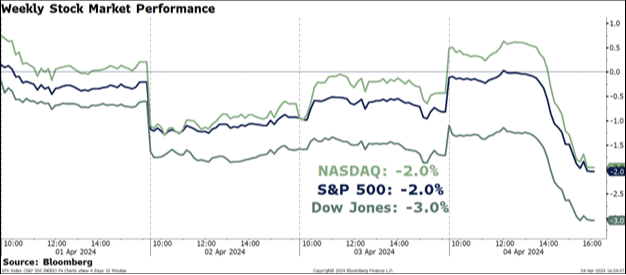
#1 – Weekly Market Recap – After a slow start to the week, Thursday saw a spike in volatility from geopolitical pressures, rising oil prices, and remarks from Minnesota Fed President Neel Kashkari hinting at no interest rate cuts in the year ahead.
The Dow Jones dropped roughly -3%, while the S&P 500 and the tech-heavy Nasdaq both fell by -2%. Thursday’s decline marked the S&P 500’s most significant single-day decrease since February 13th.
Oil futures surged +1% with West Texas Intermediate closing at $86.59 per barrel. Brent Crude, the international oil benchmark, closed at $90.65 per barrel, reaching their highest respective levels since last October.
Stocks were up this morning in early trading as the jobs report came in strong with 303,000 jobs added in March, much higher than the 200,000 estimate. As a result, the unemployment rate ticked down to 3.8% from 3.9% last month.
Wage growth was +0.3% — in line with estimates. The annual increase in wages slowed to 4.1% from 4.3%, the lowest reading since June 2021.
The strong jobs number indicates that the US economy remains strong – potentially making the Federal Reserve’s decision on when to cut rates even more difficult.
#2 – Pump Pressure – 2024 has ushered in an unexpected challenge for American motorists — a sharp rise in gas prices.
With the average price of unleaded gas at $3.54 per gallon, consumers are once again feeling a squeeze. The increase represents a staggering 14% surge since the beginning of 2024.
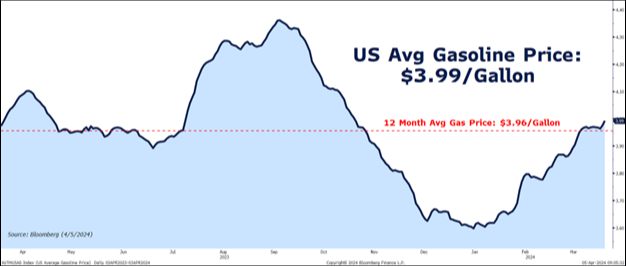
Prices have surged in 2024 as consumer travel is boosting demand while at the same time inclement weather has disrupted supply chains and refining operations. Additionally, the seasonal transition to summer blends of gas, mandated for environmental reasons, has added an extra layer of cost to gasoline production.
Geopolitical conflicts in the Middle East are also pressuring global supply and amplifying OPEC’s decision to maintain production cuts.
We have written on numerous occasions that US inflation has been declining as “flexible” inflation falls while “sticky” inflation remains elevated. Although the Federal Reserve’s preferred “core” inflation strips out volatile energy prices, we can’t help but wonder if prolonged supply challenges won’t cause a reacceleration of inflation in the short-term.
Despite these challenges, there are signs of potential relief on the horizon. The reopening of US refineries should increase supply levels. Additionally, analysts anticipate a decline in wholesale gasoline prices as incoming supply helps to rebalance the market.
Source: Wall Street Journal
#3 – Federal Reserve Losses – The Federal Reserve is one of the most written about, yet least understood, facets of banking and finance.
Whether it is the Fed’s Open Market Committee, balance sheet, quantitative easing and tightening or Operation Twist, it seems like the Federal Reserve is constantly in the news, but rarely understood.
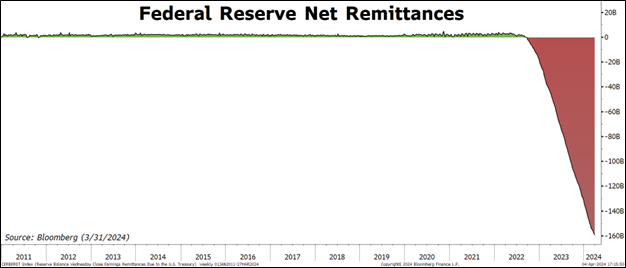
Last week, the Federal Reserve reported it had a net operating loss of $161 billion dollars over the last two years. This sounds like it could be a problem…until you understand it.
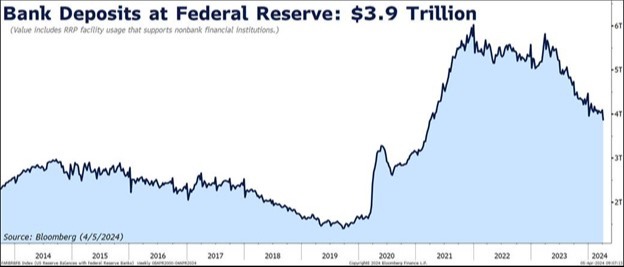
One of the functions of the Federal Reserve banks is to hold excess reserves for commercial banks. Think of the Federal Reserve as a bank for banks – banks deposit money at the Federal Reserve.
When this occurs, the Federal Reserve now (they didn’t used to) pays interest on the deposits to commercial banks. The interest rate paid by the Federal Reserve to commercial banks is the 5.25% Fed Funds Rate that is constantly referenced and written about.
In 2023, with the combination of a 5.25% Fed Funds Rate, and banks depositing roughly $4 trillion dollars of excess cash at the Federal Reserve, the Federal Reserve paid $281 billion in interest payments to commercial banks. The interest payments were basically a transfer from the Federal Reserve (which is part of the US Treasury) to commercial banks. This was good for banks and helped their profitability.
You may be wondering where the Federal Reserve got the money to pay the banks? That is the interesting part. The US Treasury prints money, gives it to the Federal Reserve (in return for an IOU to be repaid later), who turns around and pays it to banks.
If the Federal Reserve was a traditional bank, the losses would be problematic as it would erode the bank’s balance sheet (think Silicon Valley Bank in 2022). But it is not a problem for the Federal Reserve — it simply adds the losses onto its $7.4 trillion balance sheet. Unlike a commercial bank, there are no customers to pull their deposits as the loan losses increase – there is just the backing of the US Government.
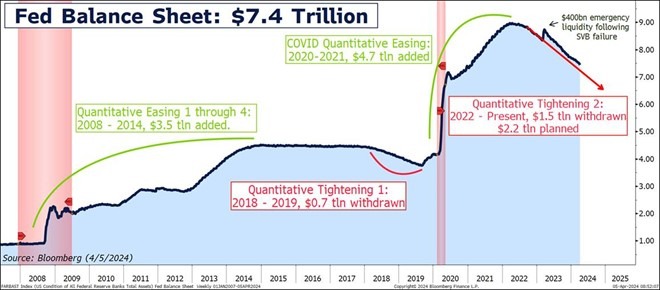
If this sounds too good to be true…it is…over the long-term. Eventually there will be a day of reckoning as the US dollar depreciates given the massive amount of money printing that is currently underway. But in the short-term, the actions of the Federal Reserve provide liquidity, and stability, to the US banking and financial system.
Source: St. Louis Fed
#4 – Return of Supersonic Flights – The last supersonic passenger flight was the Concorde’s final commercial flight in 2003. That could change as current aviation projects could revolutionize air travel making supersonic flights a reality for passengers once again.
The Concorde, with its iconic long nose, made the world a smaller place. The usual 8-hour flight from New York to London was cut to just over 3 hours for those able to afford the hefty ticket price.
Unfortunately, the Concorde met its demise after 29 years of operation. After the Air France crash in 2000, many travelers were hesitant to fly the supersonic plane. Additionally, the sonic boom – the deafening boom that results when an aircraft breaks the sound barrier – made travel across land controversial. Additionally, the planes were very expensive to operate, making it difficult for airlines to turn a profit.
Supersonic travel may return, however, as two ventures will hit major milestones later this year when they each launch test flights of their innovative supersonic aircraft. The first is a partnership between Lockheed Martin and NASA and the second is a private company called Boom Technology.
NASA and Lockheed Martin’s project called Quesst, is attempting to design a jet that makes crossing the sound barrier quieter – more like a “sonic thump,” rather than a roaring boom, according to a NASA release. Dubbed the X-59, the aircraft is expected to fly 925 miles per hour or 1.4 times faster than the speed of sound. The plane’s innovative design, unique shape and other technologies are expected to help diminish the sonic boom.
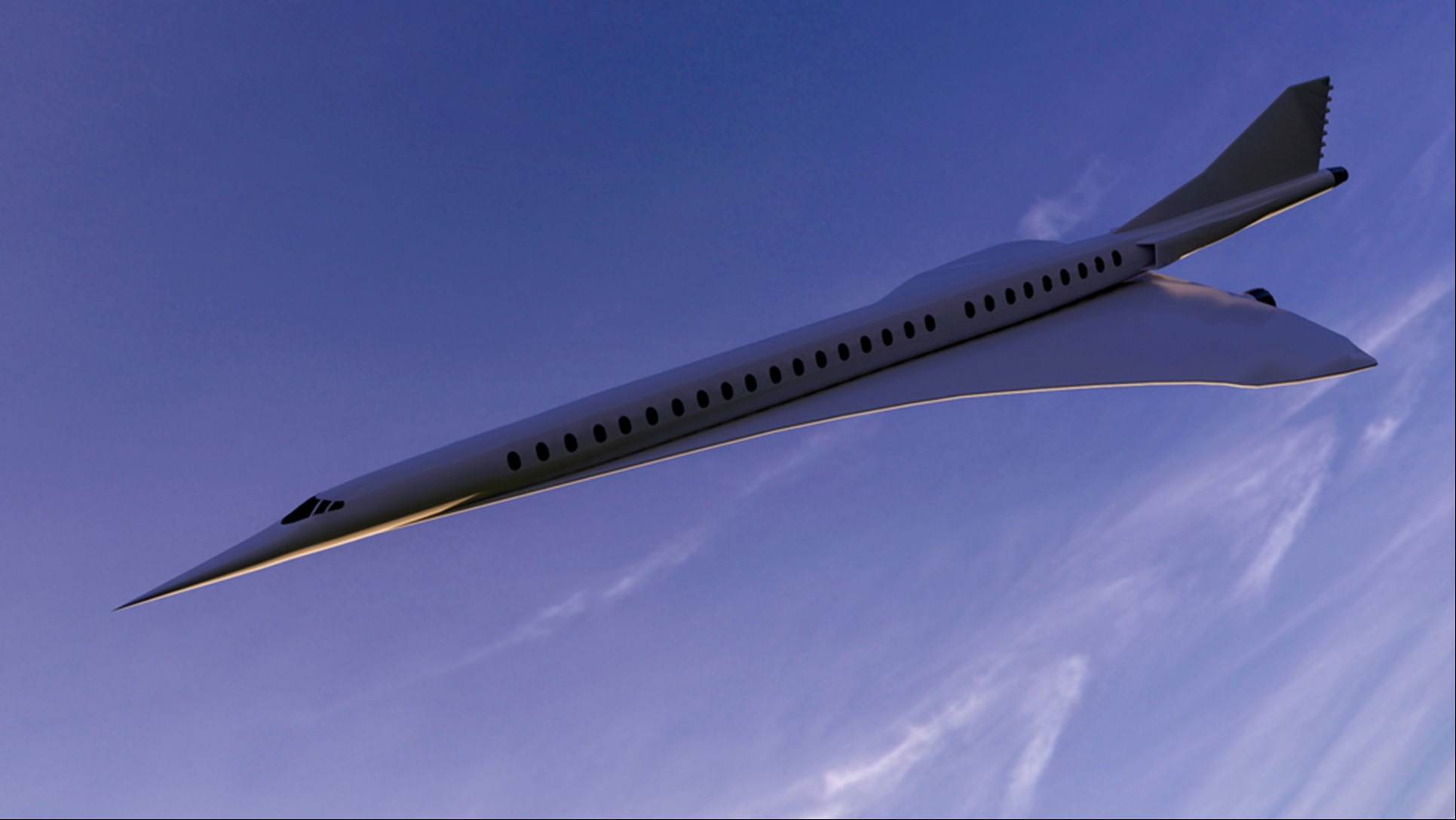
Boom Supersonic, a private company based in Colorado, is also endeavoring to make commercial supersonic flights available to passenger travel by 2029. The aircraft, named Overture, is expected to fly at speeds up to 1,300 miles per hour – or twice as fast as today’s passenger planes. The company states that the Overture is being designed to meet today’s takeoff and landing noise levels and will only cross the sound barrier over water. In the future, Boom could also leverage NASA’s quiet boom technology said a company spokesperson.
Don’t buy your tickets just yet, but in anticipation of supersonic air travel becoming mainstream, United Airlines and American Airlines have already placed orders for the Overture aircraft to be delivered in 2029. “Among the many potential routes for United are Newark to London in just three and a half hours…and San Francisco to Tokyo in just six hours,” United said when it announced the purchase.
Source: CN Traveler
Source: Washington Post
#5 – Total Eclipse – North America is just days away from a total solar eclipse — the first total eclipse since 2017.
On Monday, April 8th a total solar eclipse will begin on Mexico’s Pacific coast and cross into Texas and up through Maine before exiting over Canada.
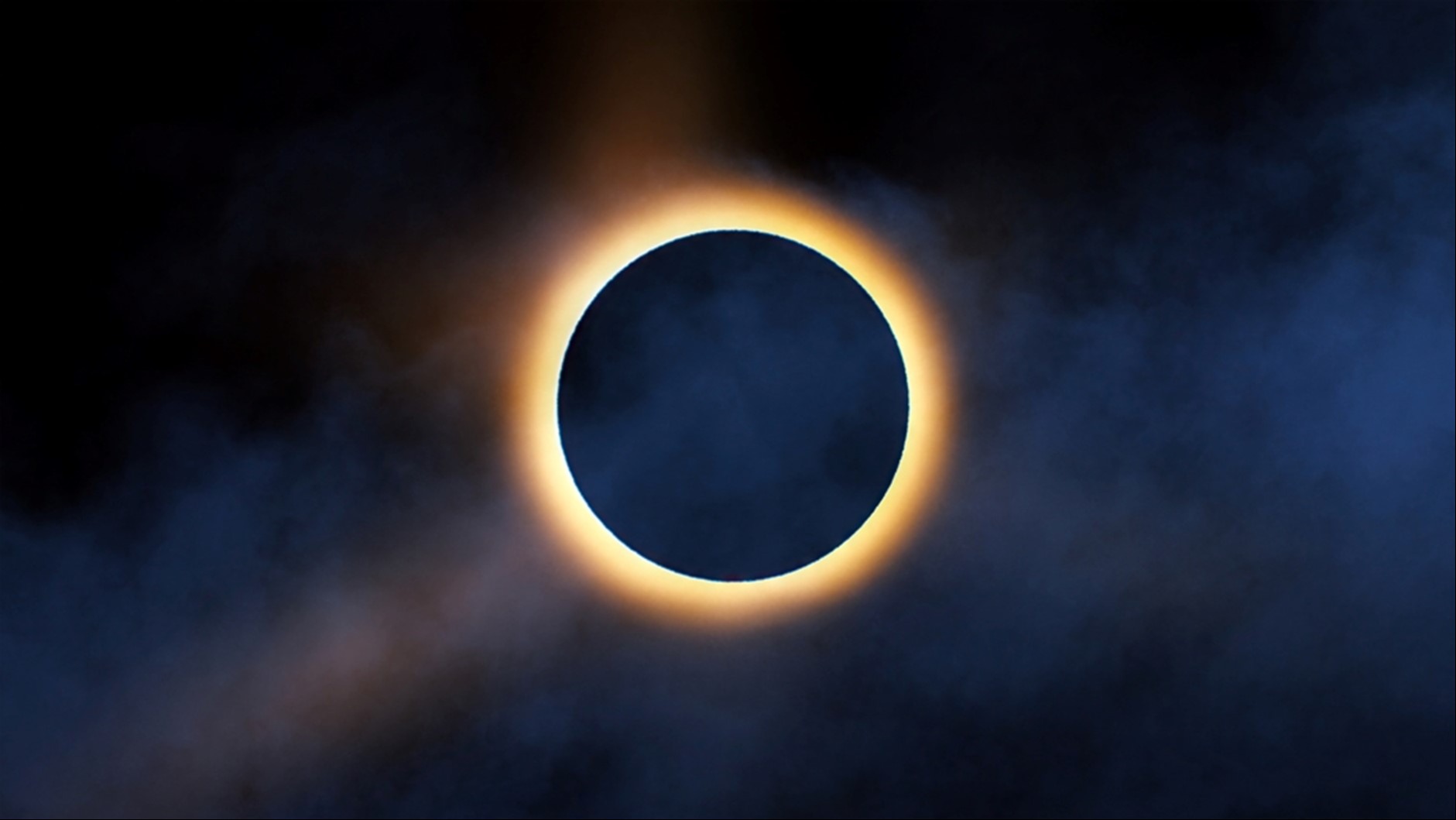
If clouds don’t get in the way, viewers in the eclipse’s path will see the moon slowly begin to cover the sun until it is completely blocked. The moon will shroud the sun for up to 4 minutes, 28 seconds. This period of darkness is called “totality” during which temperatures drop and only the sun’s corona will be visible.
How much of the total solar eclipse you will be able to will depend on where you live. An estimated 44 million people live within the path of totality, with another couple hundred million within 200 miles. Practically everyone in North America will be able to see at least a partial eclipse.
Although there’s still plenty of time for weather forecasts to change, clouds and storms are currently expected in much of the eclipse’s path. National Weather Service meteorologist Marc Chenard says the northeast US currently has the best chance of clear skies, along with parts of Arkansas, Missouri and Illinois. The storms moving across the central United States are making it tough for meteorologists to predict exactly when and where clouds will arrive.
If it’s cloudy or storming where you are, you can still watch the total solar eclipse online. NASA will stream the eclipse live (Nasa Live Stream) starting at 12pm CDT.
If you miss this year’s total solar eclipse, you will have to wait until 2045 for the next coast-to-coast total solar eclipse.
Source: AP News
Source: AP News
Have a great weekend!
Denver & the DSGCA Team