


Happy Friday!
Stocks and bonds drop on signs that inflation is “Sticky” and possibly reaccelerating. Banks start Q1 earnings season in underwhelming fashion. Monday is Tax Day and The Masters Reigns Supreme!
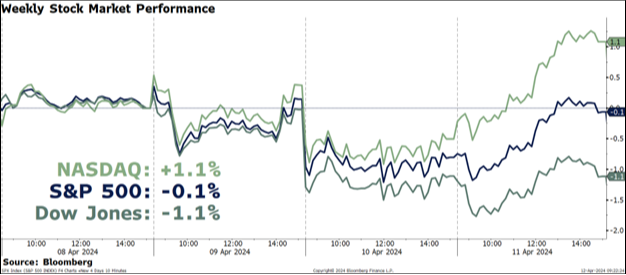
#1 – Weekly Market Recap – Another volatile week for stocks as elevated inflation put pressure on stocks and bonds. Yesterday afternoon’s market recovery reversed course this morning on underwhelming bank earnings reports.
Through Thursday’s close, the tech heavy NASDAQ lead the way up +1.15%, the S&P 500 was down slightly at -0.06% and the Dow Jones was down -1.12%.
At DSG Advisors, we expect investor focus will shift over the next several weeks from macroeconomic updates to Q1 earnings. Of course, there is more than a slight possibility that geopolitical tensions could once again take center stage.
#2 – Inflation Remains Sticky – Wednesday’s inflation report indicated that consumer inflation continues to remain elevated.
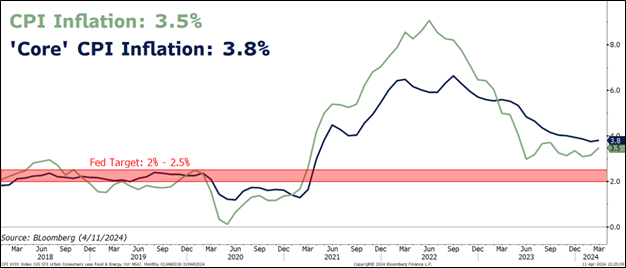
Headline CPI (Consumer Price Inflation) was up +0.4% versus a +0.3% expected rise. March’s annual consumer inflation rate increased to +3.5% from +3.2% last month. The increase was largely the result of rising rent and gas prices.
“Core” inflation, which excludes volatile food and energy prices, was also higher than anticipated and increased +0.4% versus estimates of +0.3% increase. Annual Core inflation remained unchanged at 3.8%.
Both Headline and Core CPI inflation readings remain well above the Federal Reserve’s 2% inflation target.
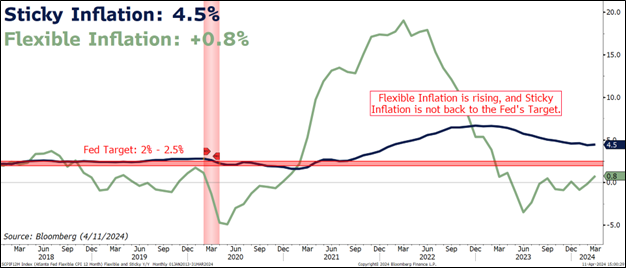
As we have written on numerous occasions, inflation can be broken down into two components: “Sticky” and “Flexible.” “Sticky” inflation measures changes in prices of goods and services whose prices are slow to change like housing, insurance and education. “Flexible” inflation measures changes in the price of goods and services whose prices change quickly like food and gas.
As seen in the chart below, although “Flexible” inflation fell quickly after the pandemic, “Sticky” inflation has slowed much more gradually.
The concerning observation for investors, as well as the Federal Reserve, is that both “Sticky” and “Flexible” inflation are rising. The higher-than-expected inflation report this week stoked fear among some investors that inflation could be reaccelerating, and anticipated interest rate cuts could be pushed out, and reduced, from what was expected just a few weeks ago.
#3 – Q1 Earnings Season – Today is the unofficial start to Q1 earnings season.
Over the next few weeks, investor’s attention will shift from macroeconomic data updates to company earnings.
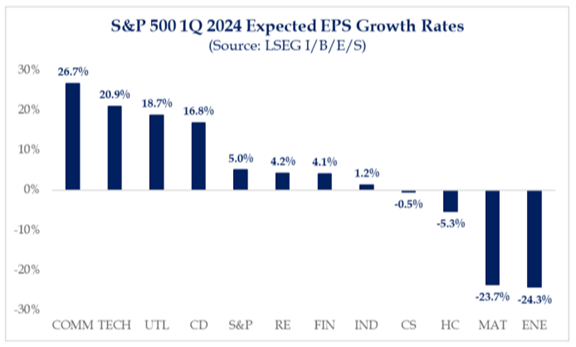
S&P 500 earnings for Q1 2024 are forecast to increase +3.2%, supported by +1.7% revenue growth.
As shown in the chart below from Strategas, Q1 EPS expected growth rates vary significantly by sector. Communication Services and Technology companies are expected to lead the way with both sectors experiencing 20%+ earnings growth.
On the other side of the spectrum, Materials and Energy companies are expected to have -20%+ earnings declines.
Major banks were the first to report Q1 earnings this morning with mixed results. Citigroup stock rose and then fell in early trading on a decline in Q1 earnings. Wells Fargo stock was up marginally after reporting a -7% decline in Q1 profit on lower customer interest payments. Finally, JP Morgan stock fell -4% as projected income from interest payments was below expectations.
According to FactSet, banks are expected to see an -18% decline in earnings as the result of weak loan growth and increased reserves for potential loan losses. One investor adage is “A healthy stock market requires healthy banks.” Unfortunately, banks are not starting Q1 earnings season on an overly positive note…investors should monitor closely to see if bank earnings are a preview for other sectors or an isolated area of concern.
Source: Forbes
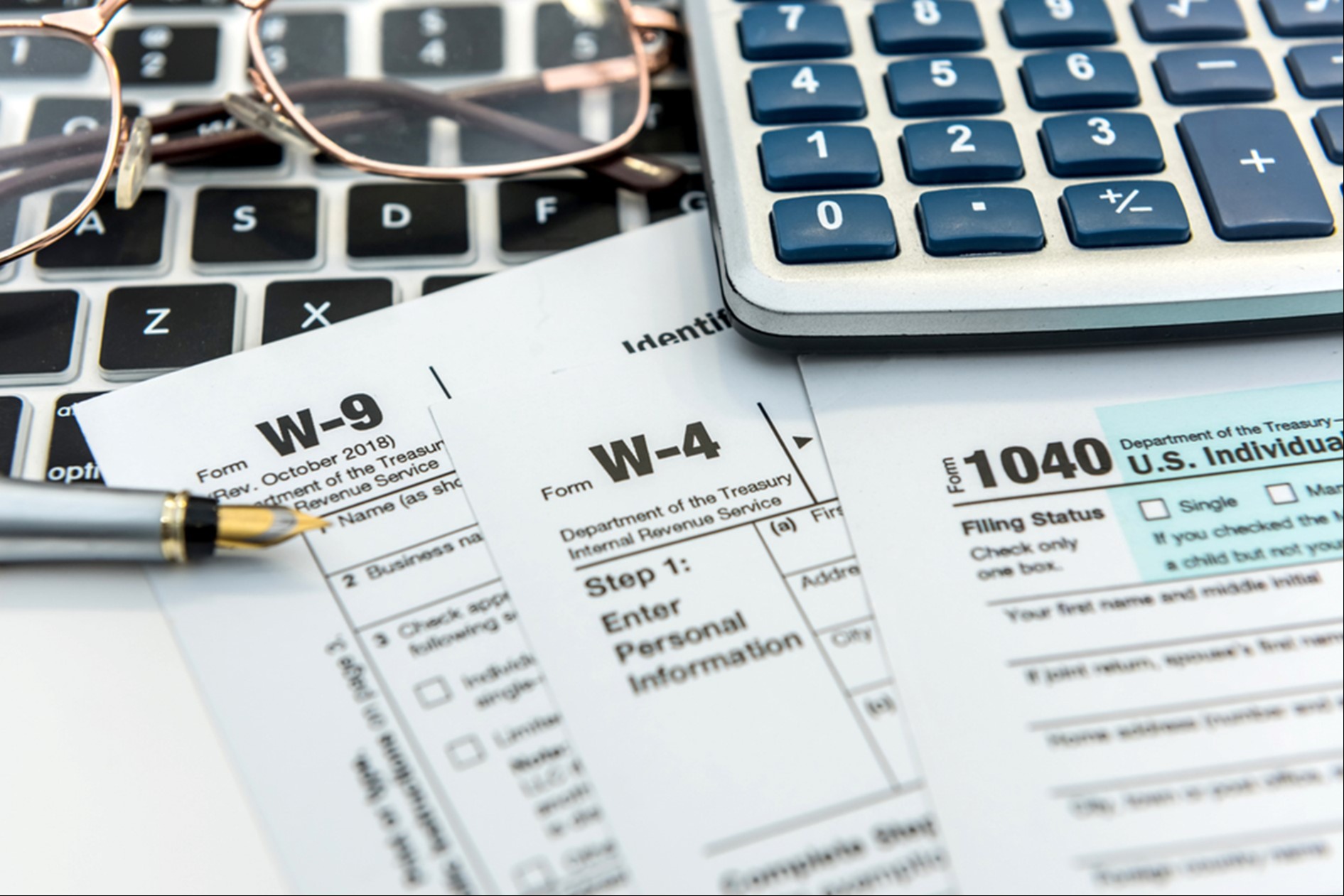
#4 – Tax Day – Monday April 15th is Tax Day.
Millions of taxpayers will spend the weekend going through the arduous process of completing and filing their tax returns to meet Monday’s tax deadline. According to a NBC News analysis of IRS data, about one third of Americans procrastinate filing their taxes because they feel it’s complicated, stressful and they don’t think they’ll get a refund.
The procrastination rate seems to have held steady since last year. Through the end of March, about 90 million returns were filed with the IRS, roughly the same as last year. However, about one third, or 50 million returns, were expected to be filed the first two weeks of April.
Taxpayers whose wages have risen after the pandemic could encounter higher tax rates through “bracket creep.” Bracket creep occurs when wages rise faster than inflation adjusted tax rates. Although earning more wages is good for workers, many people may be surprised to learn that their higher income level has pushed them into higher tax brackets.
The IRS tries to guard against “bracket creep” by adjusting tax brackets up with the rate of inflation. But for workers whose wages rose faster than the rate of inflation, or people who found new jobs and are earning more income, they may discover the unwanted impact of “bracket creep.” Of course, for anyone whose income didn’t keep up with inflation, they could actually find themselves in a lower tax bracket.
Source: NPR
Source: CNBC
#5 – The Masters – The first round of arguably golf’s most prestigious tournament teed off yesterday at Augusta National Golf Club.
The Masters Golf Tournament, often referred to as “The Granddaddy of Them All,” is the first of the four major tournaments on the PGA Tour. The annual tournament is always held during the first full week in April. Roughly 40,000 people will be lucky enough to watch the Masters live at Augusta, while the rest of us will have to be satisfied watching from home.
The Masters was the brainchild of legendary amateur golfer Bobby Jones and investment dealer Clifford Robert. The pair co-founded the Augusta National Golf Club in 1933. The first “Augusta National Invitation Tournament,” as the Masters was originally known, began on March 22, 1934, and was won by Horton Smith who earned $1,500 for his first-place finish.
Reigning champion, Jon Rahm, is attempting to be the first player since Tiger Woods in 2002 to become a back-to-back winner. Only Jack Nicklaus (1966), Nick Faldo (1990) and Woods have ever defended the iconic green jacket. The competition is always fierce, first timers rarely win – Fuzzy Zoeller was the last to do it in 1979.
Of the 89 golfers competing in the tournament, thirteen are LIV Golf players who earned invitations to this year’s Masters. One of the LIV players is last year’s Champion Jon Rahm who left the PGA tour last December to join the Saudi-backed tour. Golfers who leave the PGA Tour for LIV Golf can no longer compete in PGA Tour events. But they can compete in the Masters – and the other three majors – if they meet certain qualification rules.
Fred Ridley, chairman of the Augusta National Golf Club, said this week he’s open to inviting high-performing LIV golfers to the tournament in the future. “We’re an invitational,” he said according to Daniel Rapaport of Barstool Sports.

Source: CNN
Source: Deseret
Have a great weekend!
Denver & the DSGCA Team