


Happy Friday!
Stocks endure summer slide on weak economic data and Treasury bond auctions, but inflation appears to moderate. AI versus consumers – diverging trends. Smart bandages could heal wounds faster. Cheese rolling – a quirky English tradition.
Summer has officially begun at DSG Advisors, so the Friday Five will slim down to the Friday Four – but just until Labor Day when the “Five” returns!
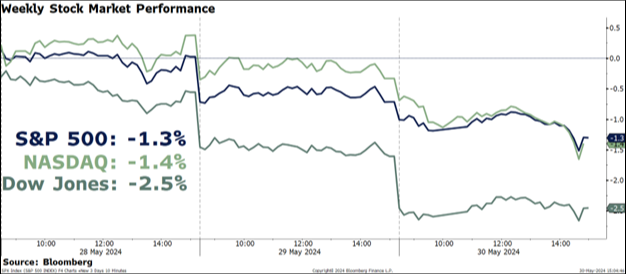
#1 – Weekly Market Recap – The unofficial start of summer brought a decline in stock prices as the result of soft economic data, weakening consumer sentiment, and weak Treasury bond auctions.
Through Thursday’s close, the Dow Jones was the largest decliner for the week partly, attributable to large declines in United Health Group and Salesforce stock. The Dow Jones has returned just over 1% for the year.
The S&P 500 and the NASDAQ were each down a more modest -1.3% and -1.4% respectively for the week.
Three straight days of >1 standard deviation moves in 10-Year Treasury yields and a downward revision of the Q1 GDP growth rate from 1.6% to 1.3% produced a cautious outlook for investors early in the week.
On Thursday, software giant Salesforce fell -20% following a weaker than expected growth forecast for the remainder of 2024. It was the largest single-day decline for the CRM software provider since 2004. The weak outlook from one of the largest US technology companies appeared to cast a negative tone on market sentiment throughout the day.
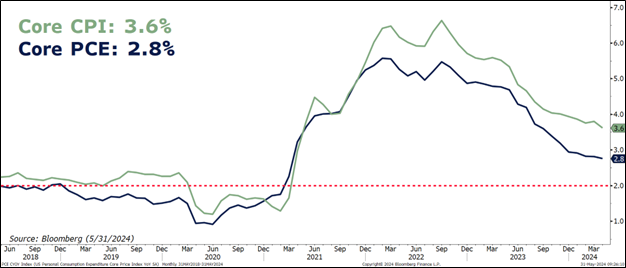
The Federal Reserve’s preferred method of monitoring inflation, the core Personal Consumption Expenditures (PCE) index, increased just +0.2% in April, slightly below the +0.3% expected increase.
Although still not near the Fed’s 2% inflation target, investors reacted positively to the continued slowing inflation data lifting stocks to end the week on a more positive tone.
Source: Salesforce Earnings CNBC
Source: UNH Investor’s Business Daily
#2 – AI vs. Consumers: Diverging Trends – As investors progress through 2024, two clear but divergent trends have unfolded.
On the one hand, the Artificial Intelligence boom is providing serious momentum to technology and AI related companies. On the other hand, persistently high prices are causing US consumers to reduce discretionary spending, creating a challenging backdrop for consumer-based companies.
These divergent trends are illustrated in the chart below that compares the +56.4% year-to-date returns of semi-conductor companies that make computer chips versus the +0.2% year-to-date return for consumer discretionary stocks.
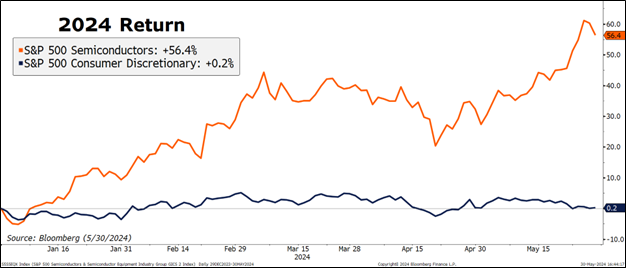
The surge in AI-related spending has been a dominant theme to start 2024 as companies race to produce what is required for advanced computing capabilities to support Artificial Intelligence.
According to Evercore Research, the six largest datacenter companies in the US have spent $330 billion over the past 2 years and anticipate spending another $470 billion over the next two years to build required AI infrastructure. That equates to $800 billion of spending just on data centers!
In contrast, a chorus of comments about weaking consumer spending can be heard from consumer-focused companies. Management from McDonalds, Target, Starbucks, LuluLemon and Best Buy, have observed that consumers appear increasingly selective with their spending as persistent inflation weighs on disposable income.
According to new research from the Federal Reserve Bank of New York, roughly 15.3% of Gen Z credit card borrowers have maxed out their credit cards. By comparison, just 4.8% of Baby Boomer borrowers and 9.6% of Gen Xers have maxed out their credit cards.
Credit card delinquencies have surpassed pre-pandemic levels and continue to rise. Severe credit card delinquencies (those 90 days overdue) have now climbed to 10.7% – the highest since 2012. These findings show that pockets of financial stress continue to emerge in the U.S. economy after three years of high inflation.
As we head into summer, we expect both the durability of AI-related spending, and the condition of the US consumer, will remain important topics for investors.
Time will tell how long these divergent trends can last. Eventually, it seems that companies will need consumer spending to increase to justify the tremendous amount of dollars being spent preparing for the AI revolution.
Source: CNN
#3 – Smart Bandages – Most often when someone gets a cut, scrape, or burn, the body takes care of itself and heals on its own. That isn’t always the case, however, with chronic wounds or burns.
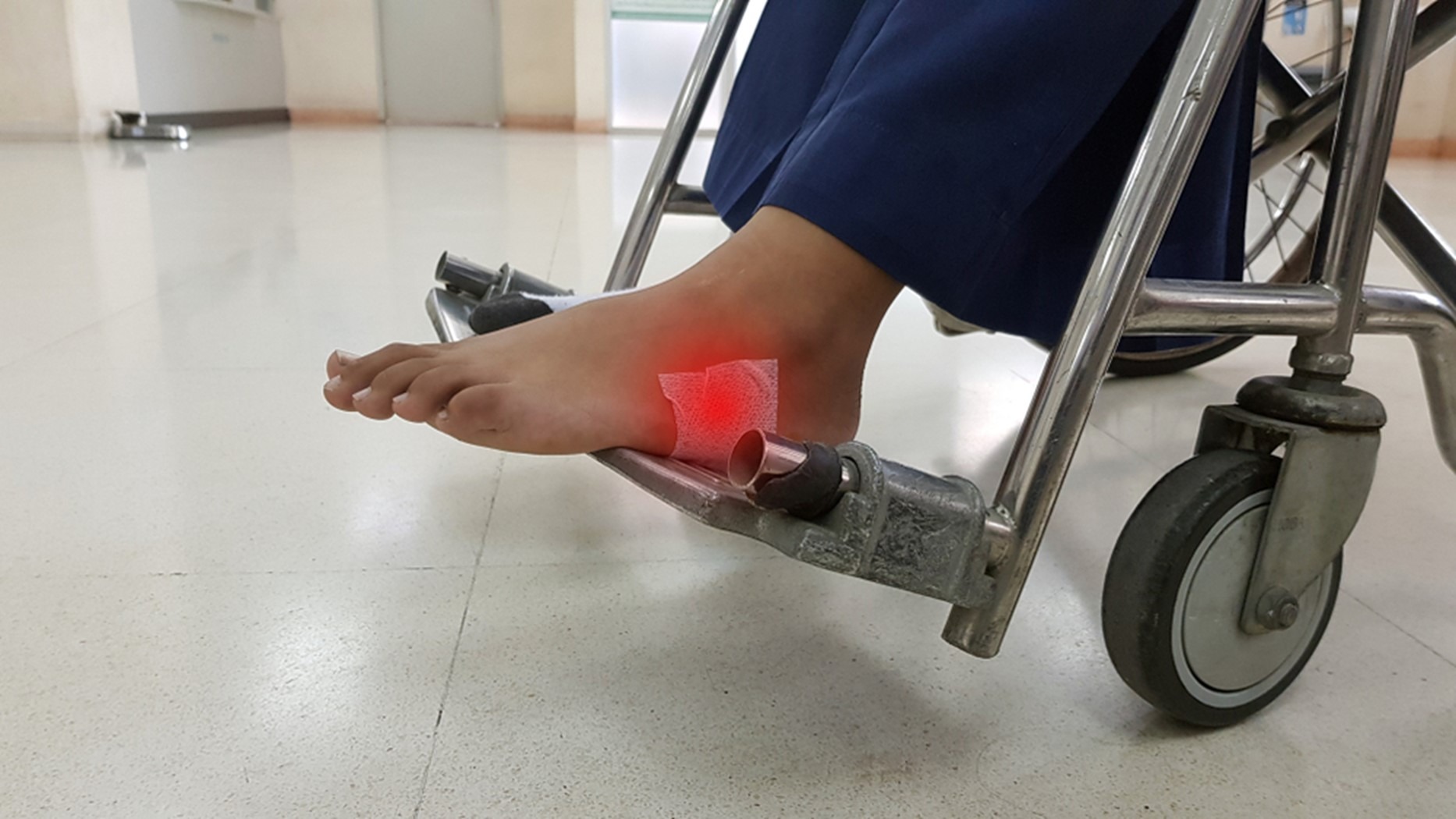
A new generation of smart bandages could heal wounds faster and more effectively than conventional gauze and ointment treatments. The technology could allow doctors to speed up the healing process by remotely dispensing treatments such as antibiotics directly to the wound.
Many of the smart-bandage prototypes include small electronics in the bandage that can detect how a wound is healing and relay that information in real time to the doctor to assist in next steps. Some high-tech bandages can even emit light rays or electrotherapy to aid in healing.
This type of technology wouldn’t be necessary for simple cuts and scrapes but could be highly effective for the 8.2 million Americans suffering from chronic wounds being cared for at home or in the hospital. It could also provide cost savings for the estimated $28 billion spent annually in the US treating chronic wounds.
Many of these inventions are still in the early stages of animal or human testing – some are still in the lab – and are far from being commercially viable.
According to Guillermo Ameer, a biomedical engineer and professor at Northwestern University, “It’s a very hot area right now. When we first started in this area five years ago, there were very few people, very few labs, looking at smart systems or smart bandages. Now we have many researchers and colleagues not only the United States, but in China and Europe, that are pursuing this.”
Source: WebMD
Source: CalTech
Source: Wall Street Journal
#4 – Cheese Rolling? – You won’t see this event at the Olympics this summer, but this past week was one of Britain’s most extreme annual events was held – cheese rolling!
Each year in southwest England, thousands of spectators’ cheer on scores of competitors as they chase 7-pound wheels of Double Gloucester cheese down the steep Cooper’s Hill near Gloucester. The winner doesn’t take home a gold medal or prize money — the first racer down the hill gets to keep the coveted fast-rolling wheel of cheese.
The annual races have been held at Cooper’s Hill since at least 1826, however the “sport” of cheese-rolling is believed to be much older.
The nearly vertical Cooper’s Hill is rife with safety concerns. Few competitors manage to stay on their feet all the way down the 200-yard hill. This year’s competition was especially rough-and-tumble due to recent rains. Members of a local rugby club were lined up at the base of the hill to catch out of control competitors.
Tom Kopke from Munich, Germany, won one of the three men’s races. He said attitude is more important than technique. “You start and then the adrenaline takes over and you just go, go, go,” he said.
Cheese rolling isn’t the only quirky competition to behold in southwest England. Just 20 miles away, the Tetbury Woolsack Races have been held since 1972. Drawing on a local tradition in the historic wool-trading town, competitors carry sacks of wool weighing nearly 60 pounds up and down a steep course on Gumstool Hill.
“England is mad. I love it,” said Kopke, the muddy, breathless winner.

Source: AP News
Have a great weekend!
Denver & the DSGCA Team